A Clark County Court Docket is an essential record that lists all scheduled cases, hearings, and motions in the county courts. It helps attorneys, litigants, and the public track the progress of legal matters efficiently. By showing case numbers, hearing dates, and assigned judges, the docket ensures that everyone involved stays informed. Clark County courts handle a variety of cases, including criminal, civil, family, and probate matters, making the docket a central tool for keeping legal proceedings organized. Checking the docket regularly allows participants to plan ahead and avoid missing important court events.
Court dockets also promote transparency by providing public access to court schedules and updates. With a Clark County Court Docket, individuals can follow motion listings, court schedules, and other procedural details. Many people use online docket lookup tools to view case timelines from home, saving time and effort. This system helps maintain order in the court system while giving citizens confidence that the process is fair and visible. Overall, the docket serves as a clear roadmap for anyone connected to a case.
How to Access Clark County Court Docket Online
Accessing the Clark County Court Docket online lets anyone check hearing dates, motion listings, and upcoming case events. Court websites offer digital tools that show official schedules and related case details in an online court calendar. You can search by case number, party name, attorney name, or citation depending on the court system.
Visit the Official Website
Open your web browser and go to: https://www.clarkcountycourts.us/
This is the main portal for Clark County courts, covering civil, criminal, family, and probate cases. From here, you can access the Court Finder tool to search dockets online.
Navigate to Court Finder
On the homepage:
- Look for the menu option “Court Finder / Case & Calendar Inquiry”
- Click the link to open the Court Finder tool:
https://www.clarkcountycourts.us/court-finder/
Enter Case Information
To perform a search, you can enter one or more of the following:
- Case Number – Most accurate search method
- Party Name – Enter first and last name of plaintiff or defendant
- Attorney Name / Bar Number – If available
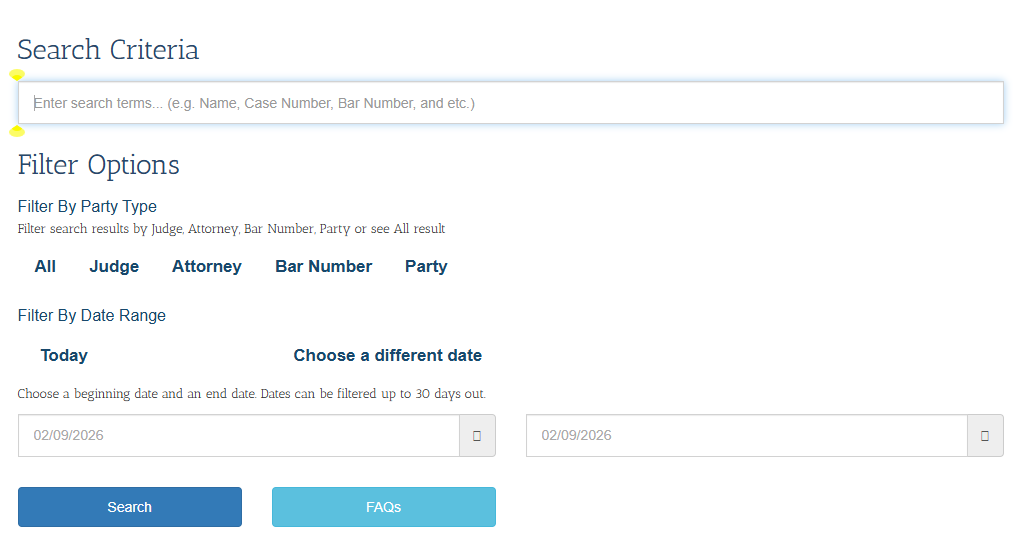
Select Filters (Optional)
Depending on the search, you can filter results by:
- Court Division – Civil, Criminal, Family, Probate
- Judge – If you know the assigned judge
- Date Range – To narrow results to specific hearing dates
Review Search Results
After clicking Search:
- You’ll see a list of matching cases.
- Each entry shows:
- Case number
- Parties involved
- Type of hearing (motion, trial, status conference)
- Date, time, and courtroom
- You can click on a case number for more detailed information about scheduled events and motions.
Check Updates
Court dockets are updated regularly:
- Hearings can be rescheduled or canceled
- New motions or filings are added
- Refresh the page or check back frequently for the latest info
Public vs Restricted Records
Most case information is public, but some cases are restricted:
- Juvenile cases – Limited access
- Family court confidential matters
- Sealed records – Not available online
Optional Features
Some helpful tools on the website:
- Download or Print Docket – Save schedules for reference
- Court Calendar View – See all hearings by date
- Search by Multiple Criteria – For attorneys managing multiple cases
Clark County Court Calendar & Hearing Schedules
A Court Calendar Clark County is an official schedule showing all upcoming court sessions, hearings, and trials in the county’s courts. It provides essential information for attorneys, litigants, and the public to keep track of case proceedings. By listing trial dates, motion hearings, and other proceeding dates, the court calendar ensures that everyone involved in a case knows when and where each session will take place.
The calendar includes a variety of hearing schedules, such as pre-trial conferences, motions, status checks, and trials. Each entry typically shows the case number, parties involved, the type of proceeding, the assigned judge, and the courtroom. Knowing how to read this information is crucial, as it allows participants to prepare for hearings, submit necessary documents on time, and avoid missing critical deadlines.
How to Read and Interpret Court Calendars
Reading a Clark County court calendar is straightforward once the key elements are understood. Each entry usually contains:
- Case Number – Unique identifier for the case
- Hearing Type – For example, motion hearing, trial, status conference, or settlement discussion
- Date & Time – When the court session is scheduled to start
- Judge / Courtroom – Indicates the presiding judge and location of the hearing
- Parties Involved – Names of plaintiffs, defendants, or petitioners
Some calendars allow users to sort by case type or court division, which is helpful when checking multiple hearings in different courts. Many courts also provide color-coded or highlighted entries for specific types of hearings, making it easier to identify critical sessions at a glance.
Frequency of Updates and Reliability
Court calendars in Clark County are updated regularly to reflect new filings, rescheduled hearings, or cancellations. Checking the calendar frequently ensures that you have the most accurate information. Although online calendars are highly reliable, unexpected changes may occur, so it’s recommended to verify the schedule through the court clerk if needed. Some courts provide a digital version of the calendar that allows users to filter by date, judge, or case type. This makes it easier to plan ahead and reduces the risk of missing hearings. Regular updates also help lawyers manage multiple cases efficiently and allow the public to follow ongoing court proceedings.
Importance of Attending Hearings and Meeting Deadlines
Attending hearings according to the hearing schedules is critical. Missing a scheduled session can lead to delays, fines, or even default judgments in civil cases. For criminal cases, failing to appear can result in warrants or other legal consequences. Court calendars also indicate filing deadlines for motions or other documents, which must be met to keep cases on track.
By using the Court Calendar Clark County, participants can:
- Track upcoming trial dates and motion hearings
- Prepare documents ahead of proceeding dates
- Stay informed about court sessions and judge assignments
- Avoid missing deadlines or rescheduled hearings
Case Timeline & Progress Tracking in Clark County
A case timeline in Clark County provides a clear overview of how a legal matter moves from filing to resolution. By tracking case progress, participants can follow hearings, motions, and trial dates efficiently, ensuring they stay informed about every stage. This timeline is a key tool for planning, meeting deadlines, and understanding the sequence of events in a case.
Case Progress
Cases in Clark County progress through several stages, each representing a key part of the case timeline. Knowing these stages helps participants anticipate hearings and prepare required documents on time.
- Filing – The case is formally submitted to the court, and a docket entry is created.
- Preliminary Hearings & Motions – Judges schedule hearings to address procedural or legal questions.
- Trial Dates – For contested cases, trials are scheduled, and parties are notified via the court calendar.
- Resolution or Judgment – After hearings or trials, the judge issues a decision, which is reflected in the docket.
Tracking Changes and Updates
Clark County court dockets are regularly updated to reflect new filings, rescheduled hearings, or cancellations. Tracking these updates is essential for staying current on a case’s progress.
- Check the online court docket frequently for the latest changes.
- Use filters for case numbers, party names, or court divisions to narrow results.
- Review motion status and hearing schedules to identify changes quickly.
- Use a Case Tracker Tool to see a visual timeline of completed and upcoming events.
Tips for Staying Updated
Monitoring a case timeline actively helps ensure no deadlines or hearings are missed. Staying informed is particularly important for attorneys, parties, and anyone involved in ongoing proceedings.
- Keep your case number handy for faster searches.
- Sign up for notifications if the court portal offers alerts on docket changes.
- Check motion and hearing updates regularly.
- Contact the court clerk if any online records are unclear or incomplete.
Types of Cases Listed in Clark County Court Dockets
A Clark County Court Docket lists all scheduled hearings, motions, and trials for cases filed in the county courts. It provides a central reference for attorneys, parties, and the public to track case progress efficiently. Different types of cases appear on the docket, each with its own timeline and schedule. By using docket lookup, participants can view case details, monitor upcoming hearings, and plan accordingly.
Civil Cases
Civil cases involve disputes between individuals, organizations, or businesses, often related to contracts, property, or personal injury. The Clark County Court Docket shows important dates for hearings, motions, and trial sessions in civil matters, helping parties stay on top of deadlines.
- Includes lawsuits, claims, and disputes between private parties.
- Hearing schedules often include pre-trial conferences, motion hearings, and trial dates.
- Court sessions may vary depending on complexity and the assigned judge.
- Parties can use docket lookup to track case progress and upcoming actions.
Criminal Cases
Criminal cases involve charges filed by the state against individuals or organizations accused of violating the law. The docket provides scheduled court dates for hearings, motions, plea bargains, and trials.
- Includes felonies, misdemeanors, and traffic violations with criminal implications.
- Motion hearings, arraignments, and trial dates are listed in chronological order.
- Important for defendants and attorneys to track hearing schedules to ensure appearances.
- Updates reflect changes in motions, continuances, or rescheduled hearings.
Family Court Cases
Family court cases involve matters such as divorce, child custody, and child support. These cases often have sensitive information, and the Clark County Court Docket provides limited but essential scheduling details.
- Includes hearings on custody, visitation, and support modifications.
- Some records may be restricted for privacy reasons, while basic hearing dates are public.
- Schedules often include mediation sessions, status conferences, and trial hearings.
- Parties can check docket lookup to confirm court dates and motion updates.
Probate Cases
Probate cases manage estate administration, wills, and guardianships. The docket lists hearings related to estate filings and probate motions.
- Includes estate settlements, guardianship appointments, and will validations.
- Court schedules show dates for hearings on petitions, objections, or inventory approvals.
- Public access may vary depending on case sensitivity and privacy rules.
- Docket lookup helps track the progress and upcoming events in probate matters.
Traffic and Justice Court Cases
Traffic and minor criminal cases are often handled in justice courts. The docket provides scheduled hearings for citations, fines, and minor infractions.
- Includes speeding tickets, parking violations, and misdemeanor citations.
- Docket entries show arraignment dates, trial dates, and motion hearings.
- Public records are typically accessible online for verification and scheduling.
- Users can filter by case type to focus on traffic or justice court hearings.
How to Read & Interpret Clark County Court Docket Entries
A docket lookup in Clark County provides detailed information about scheduled hearings, motions, and trials. Understanding how to read these entries is essential for attorneys, litigants, and the public to track the case schedule accurately. Each docket entry contains codes, abbreviations, and procedural notes that indicate what actions are scheduled and which parties are involved. Accessing Public Records helps users verify case details officially. By learning to interpret these entries, users can efficiently follow case progress, avoid missed deadlines, and stay prepared for upcoming proceedings.
Decoding Docket Entries
Clark County court dockets include abbreviations, attorney names, and procedural codes that explain the hearing type or filing status. Knowing how to decode these elements helps users quickly understand the purpose of each entry and what is required.
- Case Number – Unique identifier for the case; used for all searches.
- Hearing Type / Motion Listings – Abbreviations indicate the kind of proceeding (e.g., “MTN” for motion, “PTC” for pre-trial conference).
- Attorney Names – Represents parties’ attorneys; may appear as initials or full names.
- Courtroom / Judge – Shows the assigned courtroom and presiding judge.
- Date & Time – When the hearing or motion is scheduled to occur.
Example Docket Entries
Here are some common docket entries with explanations to help understand the structure and details.
- “12345-CIV MTN – Smith vs. Johnson – 03/15/2026 10:00AM – Judge Lee”
- 12345-CIV – Case number, civil division
- MTN – Motion hearing
- Smith vs. Johnson – Parties involved
- 03/15/2026 10:00AM – Scheduled date and time
- Judge Lee – Presiding judge
- “67890-FAM PTC – Brown Custody – 04/02/2026 09:30AM – Judge Taylor”
- 67890-FAM – Case number, family court
- PTC – Pre-trial conference
- Brown Custody – Party involved
- 04/02/2026 09:30AM – Date and time of the hearing
- Judge Taylor – Presiding judge
Confirming Accuracy of Docket Data
While Clark County dockets are updated regularly, it’s important to verify information to ensure it is accurate. Users should review entries carefully to avoid mistakes in planning or missing hearings.
- Check the official online docket for the most recent updates.
- Confirm hearing times, dates, and courtroom assignments.
- Review any continuances or rescheduled hearings indicated on the docket.
- Contact the court clerk if entries are unclear or inconsistent.
Frequently Asked Questions
A Clark County Court Docket is a detailed record showing all scheduled hearings, motions, and trials for cases filed in the county courts. It helps parties, attorneys, and the public stay informed about case progress and ensures everyone knows critical dates and deadlines. The court calendar allows users to check upcoming hearings, motions, and trials, giving a clear picture of the case timeline. These FAQs answer common questions and provide guidance on how to use Clark County court dockets effectively.
Can Anyone Access the Clark County Court Docket?
Yes, most dockets are publicly accessible, meaning anyone can perform a case lookup. Civil, criminal, probate, family, and traffic cases are generally available online. However, some cases, such as sensitive family matters, juvenile cases, or sealed records, have limited access to protect privacy. Public entries typically include case numbers, party names, hearing dates, motion listings, and assigned judges. While this information is sufficient for tracking most cases, certain details may require contacting the court clerk. Using the official docket lookup tool ensures users get accurate and up-to-date information without relying on third-party sources.
How Often Is the Court Calendar Updated?
The Clark County court calendar is updated regularly, often multiple times per week, to reflect new filings, rescheduled hearings, or cancellations. Updates include motion hearings, trial dates, status conferences, and court session changes. Because courts handle many cases simultaneously, it’s important to check the calendar frequently for any updates. Even small changes, such as moving a motion hearing or assigning a different courtroom, are reflected online. Users relying on the docket for preparation should always verify dates shortly before a scheduled appearance to ensure accuracy and avoid conflicts.
Can I Get Notifications for My Case?
Some Clark County court portals offer notifications for changes to a case schedule. These alerts can inform users of newly scheduled hearings, continuances, or decisions on motions. Notifications are often delivered via email or through portal accounts, allowing participants to stay informed without checking the docket manually every day. While this feature is useful, it may not be available for all case types, especially for sealed or restricted cases. Users interested in alerts should create an account on the official portal and ensure their contact information is up to date. Notifications help attorneys and parties avoid missed hearings, reduce the risk of penalties, and stay prepared for all scheduled court proceedings.
What to Do if Information Is Missing or Outdated?
If docket entries appear incomplete, outdated, or unclear, it is important to verify the information through official channels. Occasionally, delays in data entry or technical updates can cause discrepancies. Users should contact the court clerk directly for clarification or use the official Court Finder portal to confirm details. Critical information to check includes hearing times, courtroom assignments, motion schedules, and trial dates. Confirming this information in advance prevents misunderstandings, missed hearings, and scheduling errors. It also helps parties and attorneys plan filings and prepare for upcoming proceedings accurately.
Are There Fees for Accessing Docket Information?
Most online docket lookup tools and the court calendar are free for public use, providing access to case numbers, hearing schedules, and motion listings without charge. However, obtaining certified copies of documents, case filings, or transcripts may involve fees. Free access allows users to track court proceedings, review schedules, and monitor the status of motions. Checking the official Clark County court website ensures that users are aware of any costs before requesting special documents. Using the online docket is the fastest and most reliable way to keep track of ongoing cases while avoiding unnecessary delays or fees.